
Table of Contents
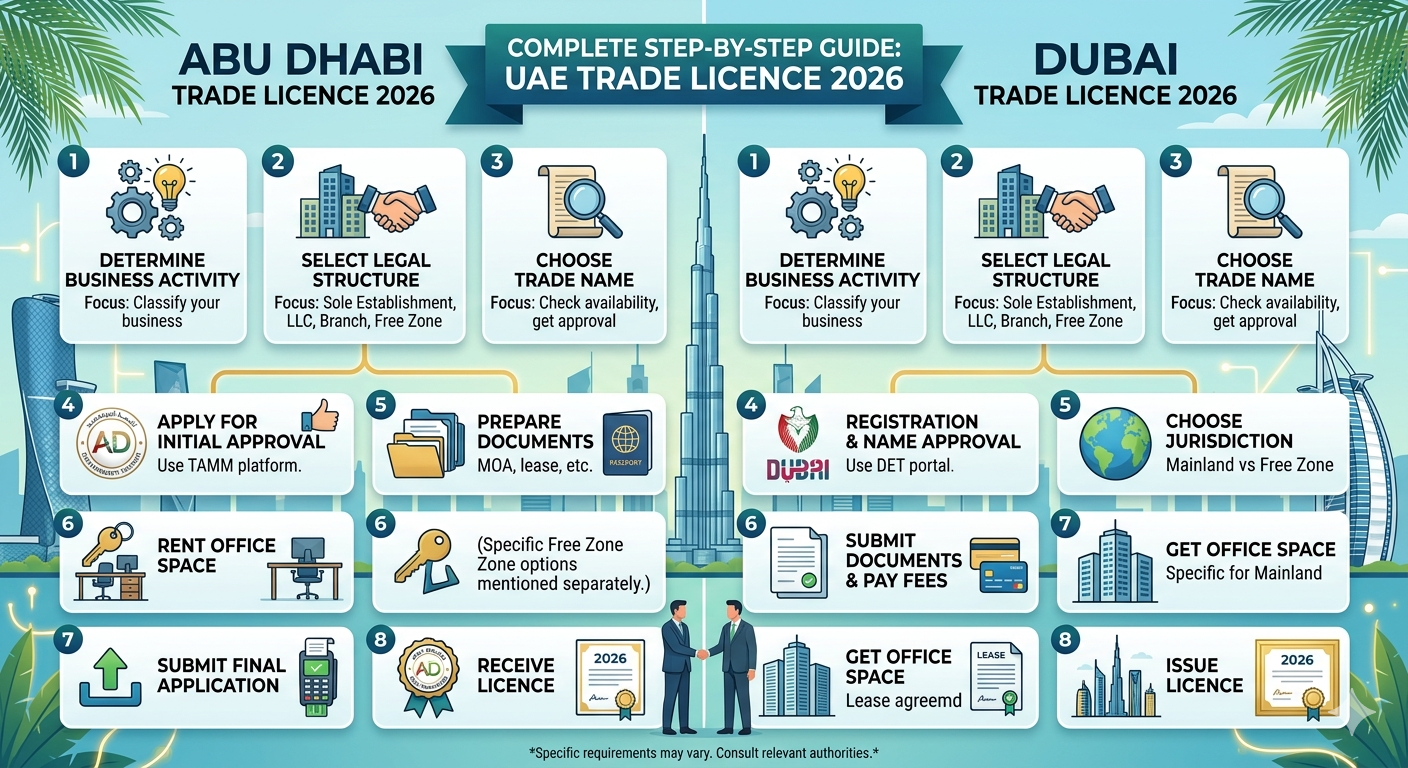
Getting a trade licence in the UAE in 2026? Whether you're setting up in Abu Dhabi or Dubai, on the mainland or in a free zone, this guide covers everything — costs, documents, timelines, and exactly which authority to go to. Updated for 2026 regulations.
What Is a UAE Trade Licence?
A UAE trade licence is the legal permit that authorises a business to operate within the UAE. It is issued by the relevant government authority depending on your emirate and business structure - and no business, whether a sole establishment, LLC, or branch office, can legally trade without one.
Think of it as your business's identity document. It specifies:
- The legal name of your business
- The business activities you are permitted to carry out
- The jurisdiction (mainland or free zone) where you operate
- The expiry date (licences are renewed annually)
Operating without a valid trade licence in the UAE carries serious penalties, including fines, business closure, and in some cases, criminal liability for the business owner.
Click here for any help - Request a free proposal
Types of Trade Licences in the UAE
The UAE issues several categories of trade licences depending on the nature of the business:
Commercial Licence - For businesses engaged in buying and selling goods. This covers trading companies, import/export firms, and retail outlets.
Professional Licence - For service-based businesses such as consultancies, law firms, accounting practices, and freelancers. There is typically no minimum capital requirement, making this the most accessible licence type.
Industrial Licence - For manufacturing and production businesses. Requires approval from the relevant industrial authority and adherence to environmental regulations.
Tourism Licence - For travel agencies, tour operators, hotels, and hospitality-related businesses. Issued in coordination with the Department of Culture and Tourism (DCT) in Abu Dhabi or the Dubai Department of Economy and Tourism (DET).
Agricultural Licence - For farming, livestock, fisheries, and related activities. Less common but available across several UAE emirates.
Most businesses starting out in the UAE will be applying for either a commercial or professional licence.
Mainland vs Free Zone: Which Is Right for You? {#mainland-vs-free-zone}
This is the single most important decision you'll make before applying for a trade licence. The two options have fundamentally different rules, benefits, and restrictions.
UAE Mainland
A mainland company is licensed by the Department of Economic Development (DED) in each emirate — ADDED in Abu Dhabi, DET in Dubai. Mainland companies can:
- Trade freely anywhere in the UAE and internationally
- Bid for government contracts
- Operate from any commercial space in the emirate
- Sponsor employees without restriction
From June 2021, the UAE amended the Commercial Companies Law to allow 100% foreign ownership of mainland companies across most business activities. A local service agent is still required for some professional licences, but the requirement for a 51% Emirati shareholder has been abolished for the vast majority of business types.
Best for: Businesses that need a physical retail presence, want to work with government entities, or plan to serve clients across the UAE without geographic restriction.
UAE Free Zones
Free zones are designated economic areas with their own regulatory authorities. There are over 40 free zones across the UAE. Key features:
- 100% foreign ownership (always, even before the 2021 law change)
- 0% corporate and personal income tax
- No customs duties on goods within the free zone
- Simplified visa processing for employees
- Cannot directly trade on the UAE mainland without a local distributor or a separate mainland licence
Popular free zones include ADGM and Twofour54 in Abu Dhabi, and DMCC, DIFC, and Dubai South in Dubai.
Best for: International businesses, e-commerce operations, import/export traders, financial services, and tech startups that don't need a physical mainland presence.
Abu Dhabi Trade Licence: ADDED Step-by-Step {#abu-dhabi-trade-licence-added}
In Abu Dhabi, mainland trade licences are issued by the Abu Dhabi Department of Economic Development (ADDED). Here is the complete process for 2026.
Step 1: Choose Your Business Activity
ADDED classifies business activities into thousands of sub-categories. You must select the correct activity code(s) for your licence — choosing the wrong code can lead to rejection or operational restrictions later.
Activities are broadly grouped under:
- Trading and commercial activities
- Professional and consultancy services
- Industrial and manufacturing
- Tourism and hospitality
You can select multiple activities under one licence, though some combinations require additional approvals from sector-specific regulators.
Step 2: Choose Your Legal Structure
The main legal structures available for mainland businesses in Abu Dhabi are:
- Sole Establishment (SE): Owned by a single individual. Full personal liability. Simplest to set up.
- Limited Liability Company (LLC): Can have 1 to 50 shareholders. Liability is limited to the share capital. Most popular structure for foreign investors.
- Branch of a Foreign Company: An extension of an existing overseas business. No separate legal personality.
- Civil Company: For professionals such as doctors, lawyers, and engineers. Can be 100% foreign-owned.
Step 3: Reserve Your Trade Name
Submit a trade name reservation through ADDED's TAMM platform (tamm.abudhabi). The trade name must:
- Be in Arabic or English (or both)
- Not duplicate an existing registered name
- Not contain offensive language or religious/political references
- Not include names of countries, governments, or international organisations without prior approval
Trade name reservation costs approximately AED 620 and is valid for 60 days.
Step 4: Obtain Initial Approval
Initial approval from ADDED confirms that the proposed business activity and structure are permissible. Some business types require external approvals before ADDED will issue the trade licence, including:
- Municipality approval for activities involving food, healthcare, or construction
- Health Authority – Abu Dhabi (HAAD) approval for medical and healthcare businesses
- Abu Dhabi Department of Culture and Tourism (DCT) for hospitality and tourism businesses
- Central Bank of the UAE for financial services
Step 5: Secure a Business Address
All mainland businesses in Abu Dhabi must have a physical, approved commercial address. You cannot use a residential address or PO Box as your primary business address. Options include:
- Leasing a commercial office or retail unit
- Registering with a business centre (flexi-desk arrangements are accepted for many professional licences)
- Taking a shared workspace that is registered with the municipality
You will need an Ejari-equivalent tenancy contract (in Abu Dhabi, this is attested by the relevant municipality or Tawtheeq system) to submit with your licence application.
Step 6: Submit the Application and Pay Fees
Once all approvals are in place, submit your complete application through TAMM or at an ADDED service centre. Required documents include:
- Completed application form
- Passport copies of all shareholders and managers
- Attested memorandum of association (for LLCs)
- Tenancy contract (Tawtheeq-attested)
- Initial approval certificate
- Any external regulatory approvals
Step 7: Receive Your Trade Licence
Upon approval and payment of all fees, ADDED will issue your trade licence. The licence is typically valid for one year from the date of issue.
Dubai Trade Licence: DET Step-by-Step {#dubai-trade-licence-det}
In Dubai, mainland trade licences are issued by the Dubai Department of Economy and Tourism (DET), formerly known as the Dubai DED. The process is similar to Abu Dhabi but uses the Dubai Now and DET platforms.
Step 1: Define Your Business Activity
DET maintains a comprehensive list of licensed business activities. Some activities are restricted to UAE nationals, while others require special approvals from sector regulators such as:
- Dubai Health Authority (DHA) for medical activities
- Knowledge and Human Development Authority (KHDA) for education
- Real Estate Regulatory Agency (RERA) for property-related activities
- Dubai Financial Services Authority (DFSA) if operating in DIFC
Step 2: Choose Your Legal Structure
DET offers the same core legal structures as ADDED. For most foreign investors setting up a trading or services business, an LLC or sole establishment is the most practical choice.
Step 3: Reserve Your Trade Name
Trade name reservation in Dubai is done through the DET portal or DED Trader app. The name must comply with the same rules as Abu Dhabi (no duplicates, no offensive terms, must reflect the business activity). Reservation costs approximately AED 620–680 and is valid for 60 days, extendable once.
Step 4: Obtain Initial Approval and External Approvals
DET issues an initial approval (also called a pre-approval) that allows you to proceed with remaining steps. Sector-specific approvals must be obtained before the final licence is issued. For businesses operating from certain areas - including Dubai Silicon Oasis or Dubai Internet City - you may also need NOCs from those zone authorities even if you hold a mainland licence.
Step 5: Lease Commercial Space and Register the Ejari
All Dubai mainland businesses must have an Ejari-registered tenancy contract. Ejari is Dubai's tenancy registration system operated by RERA. Your contract must be registered before you can complete the licence application.
Flexi-desk or business centre arrangements are accepted for professional licences in Dubai, but commercial and industrial licences typically require a physical unit.
Step 6: Notarise the Memorandum of Association (LLC only)
For LLCs, the memorandum of association (MOA) must be drafted and notarised at a Dubai Notary Public or through the DET's notarisation service. This document outlines shareholder details, share percentages, and the objects of the company.
Step 7: Submit and Pay
Submit the complete application through the DET portal, an Amer Centre, or a registered business setup service. Pay all applicable fees. Licence issuance is typically within 1–3 working days for straightforward applications after all documents are in order.
Trade Licence Fees in 2026 {#trade-licence-fees-in-2026}
Fees vary by business activity, legal structure, emirate, and the number of activities included. Below are indicative fee ranges for 2026. Always confirm current rates with ADDED, DET, or your business setup consultant before applying.
Abu Dhabi (ADDED) - Indicative Fees
Fee ComponentApproximate Cost (AED)
Trade name reservation - 150
Initial approval - 250–350
Licence issuance (commercial) - 5,500–8,000
Tawtheeq registration - 150–200
Chamber of Commerce membership - 2,000 - 3,500
Dubai (DET) - Indicative Fees
Fee ComponentApproximate Cost (AED)
Trade name reservation - 620–680
Initial approval - 100–200
Licence issuance (commercial) - 10,000–15,000
Ejari registration - 100–500
Chamber of Commerce membership - 2000–3,500
Free Zone Licences - Indicative Fees
Free zone fees vary significantly between zones. As a general guide:
Free ZoneStarting Package (AED)
ADGM (Abu Dhabi) - 15,000–25,000
Twofour54 (Abu Dhabi) - 7,500–15,000
DMCC (Dubai) - 18,000–35,000
DIFC (Dubai) - 20,000+
Smaller free zones (Ajman, RAK, Fujairah) - 5,000–12,000
Note: These figures do not include visa fees, office costs, or third-party professional fees. Total setup costs including a physical office are typically significantly higher.
Documents Required {#documents-required}
While requirements vary by business type and structure, the following documents are required for most UAE trade licence applications:
For all applicants:
- Passport copies of all shareholders, managers, and authorised signatories
- Passport-sized photographs
- Completed application form
- Attested tenancy contract (Ejari in Dubai / Tawtheeq in Abu Dhabi)
For LLCs:
- Memorandum of Association (MOA) — notarised
- Shareholder resolution (if a corporate shareholder is involved)
- Certificate of incorporation of the parent company (if applicable), attested and legalised
For branches of foreign companies:
- Parent company registration documents (attested and legalised)
- Board resolution authorising the UAE branch
- Power of attorney for the UAE manager
For regulated activities:
- Professional qualifications and NOC from relevant UAE regulatory authority
- Health certificates or background checks (for certain professional categories)
How Long Does It Take? {#how-long-does-it-take}
Straightforward applications: 3–7 working days from submission of complete documents.
Applications requiring external approvals: 2–6 weeks, depending on the regulator. Healthcare, financial services, and educational activities typically take the longest.
Free zone licences: 1–5 working days in most cases once documents are submitted, as free zones have streamlined internal processes.
The most common reason for delays is incomplete documentation or missing approvals. Getting your documents professionally reviewed before submission can cut processing time significantly.
Trade Licence Renewal in the UAE {#trade-licence-renewal-in-the-uae}
UAE trade licences must be renewed annually, typically before the expiry date to avoid fines and a lapse in legal trading status.
Key renewal steps:
- Check your expiry date - ADDED and DET both send reminders, but do not rely on them.
- Renew your tenancy contract - Your Ejari or Tawtheeq registration must be current at the time of renewal.
- Clear outstanding violations - Any pending fines or regulatory violations must be settled before renewal.
- Pay renewal fees - Similar to issuance fees, though some licences attract a different renewal rate.
- Update your activities - Renewal is an opportunity to add or remove business activities if your operations have changed.
Late renewal penalties: ADDED and DET both charge late fees for licences renewed after the expiry date. Businesses operating on an expired licence can face fines and, in serious cases, suspension of operations.
Pro tip: Start the renewal process at least 30 days before expiry, especially if your tenancy contract also needs to be renewed.
Common Mistakes to Avoid {#common-mistakes-to-avoid}
Choosing the wrong activity code. This is the most frequent and costly error. Using an incorrect code means you are technically operating outside the scope of your licence, even if your actual business is perfectly legal.
Not attesting foreign documents properly. Any documents from outside the UAE - including company registration certificates, educational qualifications, or powers of attorney - must go through the correct attestation chain: notarisation in the country of origin → Ministry of Foreign Affairs attestation in the country of origin → UAE Embassy attestation → UAE Ministry of Foreign Affairs (MOFA) attestation.
Using an unregistered address. Your business address must be properly registered under your name. Using a friend's office or an unregistered co-working space can invalidate your licence application or create problems during inspections.
Ignoring external regulatory requirements. Some applicants focus on the DED or ADDED licence and overlook mandatory approvals from sector regulators. Obtaining the trade licence first and the sector approval later is not possible for restricted activities - both must be in place simultaneously.
Missing the renewal deadline. The UAE authorities do not grant grace periods as a matter of routine. Mark your renewal date in your calendar with a 45-day reminder.
FAQs {#faqs}
Can a foreigner get a 100% ownership trade licence in the UAE mainland? Yes. Since the 2021 amendment to the Commercial Companies Law, most mainland business activities allow 100% foreign ownership. A small number of strategically sensitive activities still require UAE national partnership. Check the ADDED or DET approved activity list for your specific activity.
Do I need to be physically present in the UAE to apply for a trade licence? For most applications, a power of attorney allows a representative to act on your behalf. However, some steps - such as notarisation of the MOA - may require your physical presence or a notarised POA from your home country.
Can I have more than one activity on my trade licence? Yes. Most licences allow multiple related activities. However, combining activities across very different regulatory domains (for example, food trading and financial services) may not be permitted under a single licence.
What is the difference between a trade licence and a business licence? In UAE usage, the terms are used interchangeably. The official document is referred to as a "trade licence" by ADDED and a "business licence" in some free zones, but they refer to the same legal permit.
Can I operate from home with a UAE trade licence? The UAE launched the "Home-Based Business" licence category, allowing certain professionals and micro-businesses to register a home address as their business address under specific conditions. This is available in both Abu Dhabi and Dubai but is limited to designated business activity types.
What happens if I let my trade licence expire? An expired licence means your business is operating illegally. Fines begin accruing from the expiry date. Your visa and residency status - if linked to the licence - can also be affected. Renew on time.
Ready to Get Your UAE Trade Licence?
Navigating the UAE trade licence process involves multiple government portals, external approvals, and document requirements that vary depending on your activity and emirate. Getting it right the first time saves time, money, and significant frustration.
Takhlees Business specialises in UAE business setup and trade licence services. Our team handles the entire process on your behalf — from initial activity selection through to licence issuance and first-year renewal. Request a free proposal →